On the morning of July 16, 1945, in a remote stretch of New Mexico desert called the Jornada del Muerto — the Journey of the Dead Man — a group of scientists huddled in bunkers ten miles from a steel tower. At the top of that tower sat a device they had spent three years building, a sphere of plutonium surrounded by precisely shaped explosive lenses designed to compress the metal to supercritical density. At 5:29 a.m., the desert night became brighter than a thousand suns. The blast wave knocked observers off their feet. A mushroom cloud rose 40,000 feet into the sky. J. Robert Oppenheimer, the physicist who had led the project, later recalled a line from Hindu scripture: "Now I am become Death, the destroyer of worlds."
The Trinity test, as it was codenamed, was the culmination of the Manhattan Project — a secret program that employed over 125,000 people, cost nearly $2 billion (roughly $30 billion in today's dollars), and was conducted with such extraordinary secrecy that Vice President Harry Truman didn't learn of its existence until he became president. It was, by any measure, the most ambitious scientific and industrial undertaking in human history. And it began with a letter.
Quick Facts
Einstein's Letter
In August 1939, Albert Einstein — a pacifist who had fled Nazi Germany — signed a letter to President Franklin Roosevelt warning that recent advances in nuclear physics made it conceivable that an atomic bomb of extraordinary destructive power could be built, and that Germany might already be working on one. The letter, drafted largely by physicist Leó Szilárd, was one of the most consequential documents of the twentieth century. Roosevelt took it seriously. He established a committee to investigate, and the slow machinery of government began to turn.
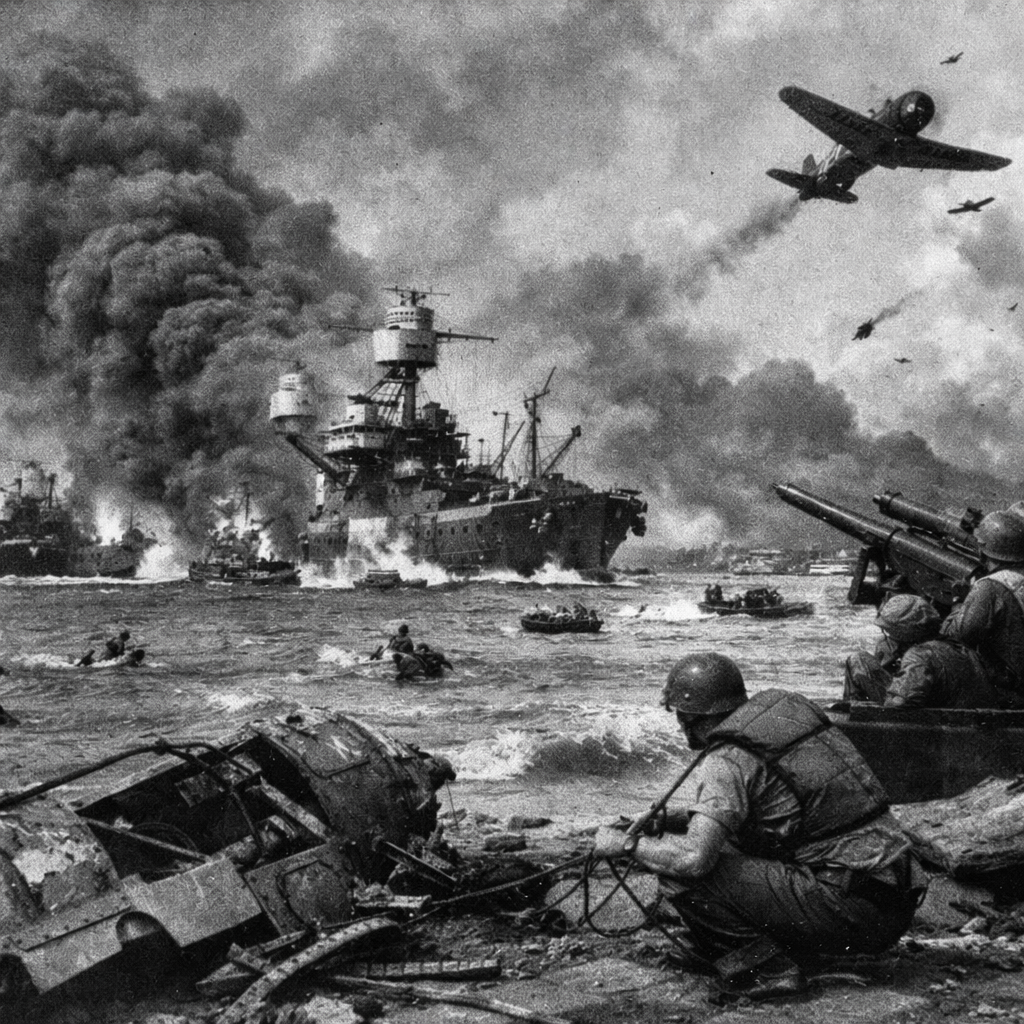
For two years, the effort proceeded cautiously. It wasn't until December 6, 1941 — the day before Pearl Harbor — that Roosevelt authorized a full-scale crash program to develop an atomic weapon. The attack on Pearl Harbor the next day removed any remaining hesitation. America was at war, and the race to build the bomb became a matter of national survival.
Secret Cities
The Manhattan Project created entire cities that didn't officially exist. At Oak Ridge, Tennessee, a facility the size of a small country was built to enrich uranium. At its peak, Oak Ridge consumed more electricity than New York City. The workers — tens of thousands of them — knew they were contributing to the war effort but had no idea what they were actually making. Compartmentalization was absolute: each person knew only what they needed to perform their specific task.
At Hanford, Washington, enormous reactors were constructed along the Columbia River to produce plutonium — an element that had been created in a laboratory for the first time only two years earlier. The engineering challenges were staggering. No one had ever built a nuclear reactor on an industrial scale. The Hanford engineers were essentially inventing an entirely new technology while racing against time.
And at Los Alamos, New Mexico — a mesa-top community accessible only by a single winding road — Oppenheimer assembled the most extraordinary concentration of scientific talent ever gathered in one place. Nobel laureates worked alongside graduate students. Theoretical physicists argued with explosives experts. The average age of the senior scientists was around 25. Oppenheimer, at 38, was considered an elder statesman.
"Now I am become Death, the destroyer of worlds."
— J. Robert Oppenheimer, quoting the Bhagavad Gita, after witnessing the Trinity test
The Race Against Germany
The scientists at Los Alamos were driven by a single, terrifying fear: that Hitler would get the bomb first. Many of the project's key figures — including Oppenheimer, Szilárd, Hans Bethe, Edward Teller, and Enrico Fermi — were refugees from fascism, or had colleagues and family members trapped in occupied Europe. For them, the bomb wasn't an abstraction. It was a desperate countermeasure against a regime they knew to be capable of unspeakable evil.
In reality, the German nuclear program was far behind. Werner Heisenberg, the brilliant physicist who led Germany's effort, had made critical errors in his calculations for reactor design. The program was also hampered by the Nazis' own ideology — their persecution of Jewish scientists had driven many of the world's finest nuclear physicists directly into the arms of the Allies. By the time of Germany's surrender in May 1945, the German bomb project had produced nothing approaching a working weapon.
But Germany's surrender created a profound moral crisis for many of the Manhattan Project scientists. The original justification — preventing a Nazi atomic bomb — was gone. Japan, though still fighting ferociously, had no nuclear program. Some scientists, led by Szilárd, petitioned directly to President Truman, arguing that the bomb should not be used against Japanese cities without warning. Others advocated for a demonstration blast on an uninhabited target. These petitions were overruled.
Hiroshima and Nagasaki
On August 6, 1945, a B-29 bomber named the Enola Gay dropped a uranium bomb — codenamed "Little Boy" — on the Japanese city of Hiroshima. The explosion killed an estimated 80,000 people instantly. Tens of thousands more would die in the weeks and months that followed from burns, radiation sickness, and injuries. Three days later, a plutonium bomb — "Fat Man" — was dropped on Nagasaki, killing approximately 40,000 people immediately.
On August 15, 1945, Japan announced its surrender. The most destructive war in human history was over. But the debates over whether the bombs were necessary — whether a demonstration or continued conventional bombing would have achieved the same result, whether the civilian death toll could be justified by the lives saved from a land invasion of Japan — have never ended. They remain among the most contested moral questions of the modern age.
The Scientists' Reckoning
The aftermath haunted many of the scientists who built the bomb. Oppenheimer, who had led the project with extraordinary skill and charisma, became one of the most vocal advocates for international control of nuclear weapons. His reward was to be stripped of his security clearance in 1954 during a humiliating hearing driven by Cold War paranoia and political enemies. He was effectively branded a security risk — the man who had built America's most powerful weapon was deemed too dangerous to be trusted with its secrets.
Einstein, whose letter had helped set the project in motion, called it the greatest mistake of his life. Szilárd devoted himself to arms control. Many of the younger scientists channeled their guilt into activism, founding organizations like the Federation of American Scientists and the Bulletin of the Atomic Scientists, whose famous Doomsday Clock became a symbol of the nuclear threat.
The Manhattan Project didn't just create a weapon. It created the modern world — a world where humanity possesses the power to destroy itself, and where the question of whether that power can be controlled remains unanswered. The scientists who built the bomb understood this better than anyone. They had split the atom and, in doing so, split the future into two possible paths: one leading to annihilation, the other to a fragile, negotiated peace. More than eighty years later, we are still walking the line between them.