The knock came at three in the morning. Jean-Pierre Moreau — a dairy farmer in the rolling countryside south of Limoges — had been expecting it for two days. He pulled on his boots, lit no lamp, and opened the back door to find his neighbor Marcel standing in the rain beside a tall, shivering figure in a torn flight jacket. The stranger's left arm hung at an unnatural angle. He smelled of aviation fuel and blood. "American," Marcel whispered. "B-17. Came down in Duval's wheat field." Moreau nodded, asked no questions, and led the injured airman to the root cellar beneath his barn. He splinted the arm with a plank and strips of bedsheet. His wife brought soup, bread, and a blanket. The airman would stay hidden there for eleven days before being passed along to the next link in an escape network that stretched across France, over the Pyrenees, and into neutral Spain.
Jean-Pierre Moreau was not a soldier. He had no training in espionage, no particular political ideology, no appetite for violence. He was a man with a cellar, a conscience, and the quiet conviction that some things mattered more than his own survival. If the Germans had found the airman, Moreau would have been shot — or worse, sent to a concentration camp along with his wife and their three children. He knew this. He hid the airman anyway. Across occupied Europe, from the fjords of Norway to the islands of Greece, tens of thousands of people made the same choice. They are remembered collectively as the Resistance, but they were not one movement. They were hundreds of movements, thousands of individual decisions, a vast and fragile web of ordinary people who decided that occupation was intolerable and silence was complicity.
Quick Facts
The French Resistance and the Maquis
When France fell in June 1940, the speed and totality of the collapse left the nation in a state of collective shock. The armistice divided the country in two: the northern zone under direct German occupation, and the southern zone governed by the collaborationist Vichy regime under Marshal Pétain. Most French citizens, stunned and exhausted, accepted the new reality. But from the very first days, a scattered minority refused. On June 18, 1940 — the day after Pétain announced he was seeking an armistice — Charles de Gaulle broadcast from London his famous appeal: "France has lost a battle. But France has not lost the war."
In the beginning, resistance was small, cautious, and deeply dangerous. It started with gestures — chalking "V" for victory on walls, distributing underground newspapers, cutting telephone lines. These acts seem modest now, but in an occupied country where the penalty for possessing a clandestine newspaper could be deportation or death, every small defiance carried enormous risk. Gradually, the scattered acts of rebellion coalesced into networks. Intelligence circuits gathered information on German troop movements, coastal defenses, and military installations, transmitting it to London by radio. Escape lines — like the one that would eventually carry the airman from Moreau's cellar to safety — were organized with extraordinary precision, each link in the chain knowing only the link before and the link after, so that a single arrest could not unravel the whole network.
By 1943, the Resistance had grown from a handful of daring individuals into a significant military force. The Maquis — named after the dense scrubland of Corsica and southern France where outlaws had traditionally hidden — were bands of armed fighters who operated from forests, mountains, and remote villages. Many were young men fleeing the Service du Travail Obligatoire, the compulsory labor service that sent French workers to German factories. Rather than board the trains, they took to the hills. They were supplied with weapons, explosives, and money by the British Special Operations Executive and the American Office of Strategic Services, dropped by parachute on moonlit nights into fields marked by bonfires.
"In the Resistance, you learned that the most dangerous thing was not the Germans. It was the person standing next to you — because you never knew if they were brave or broken."
— Lucie Aubrac, French Resistance fighter
As D-Day approached, the Resistance became an integral part of Allied planning. In the weeks before and after June 6, 1944, Maquis fighters cut railway lines, destroyed bridges, ambushed German convoys, and disrupted communications across France. The Plan Vert alone — the coordinated sabotage of the French railway system — cut more than 950 rail lines in a single night, crippling German efforts to move reinforcements to Normandy. The Plan Violet targeted telecommunications. The Plan Tortue attacked road networks. Eisenhower later estimated that the French Resistance was worth fifteen divisions to the Allied cause — roughly 200,000 soldiers.
Churchill's Secret Army: The SOE
In July 1940, with France fallen and Britain standing alone, Winston Churchill authorized the creation of a new and unconventional organization. The Special Operations Executive — the SOE — was given a mandate that Churchill summarized in three words: "Set Europe ablaze." Its mission was to conduct espionage, sabotage, and reconnaissance in occupied Europe, and to aid local resistance movements. It was, in effect, a factory for producing chaos behind enemy lines.
The SOE recruited from an unlikely pool. Its agents were not career soldiers but linguists, academics, businesspeople, journalists — anyone who could pass as a native in an occupied country. They were trained in silent killing, demolitions, wireless telegraphy, lock-picking, and the dark arts of clandestine warfare at a network of secret schools scattered across the English countryside. Their instructors taught them how to derail a train, how to forge identity documents, how to resist interrogation, and how to swallow a cyanide pill if resistance failed.
The agents were dropped into occupied territory by parachute or landed by small boats and light aircraft on improvised airstrips. They carried forged papers, concealed radios, and enough French francs or Dutch guilders to establish themselves. Their life expectancy was measured in weeks. The Gestapo was ruthlessly efficient at tracking radio transmissions — a wireless operator transmitting from the same location for more than twenty minutes was likely to be found. Many agents were captured, tortured, and executed. Of the 470 SOE agents sent into France, 118 did not return. Of the women agents sent to France, a disproportionate number were killed — in part because the Gestapo found it inconceivable that the British would send women on such missions, making them initially less suspicious but ultimately more vulnerable when caught.
The Dutch Resistance: Hiding in Plain Sight
The Netherlands, small and flat and densely populated, offered none of the geographical advantages that aided resistance in France's mountains or Yugoslavia's forests. There were no remote valleys in which to hide, no impenetrable terrain from which to launch guerrilla attacks. And yet the Dutch Resistance became one of the most effective in occupied Europe, precisely because it specialized not in armed combat but in something equally dangerous and arguably more heroic: hiding people.
An estimated 25,000 to 30,000 Jews were hidden by Dutch families and resistance networks during the occupation — in attics, cellars, back rooms, and specially constructed hiding places behind false walls and under floorboards. The most famous case is that of Anne Frank, whose family was hidden for two years in a secret annex above an Amsterdam office building before being betrayed and deported. But for every Anne Frank whose story is known, there were thousands of anonymous Dutch families who took the same risk. Hiding a Jewish person was punishable by death or deportation. The families who did it lived in constant fear — of nosy neighbors, of routine searches, of the knock on the door that would mean the end for everyone in the house.
"What is the point of living if you cannot help others who are in need?"
— Miep Gies, who helped hide the Frank family
The Dutch Resistance also excelled at forging identity documents. The German occupation required every Dutch citizen to carry an identity card — the persoonsbewijs — which included a photograph, fingerprint, and for Jewish citizens, a large "J" stamped on the front. Resistance forgers, working with stolen blank cards, official stamps, and extraordinary skill, produced thousands of false documents that allowed Jews and other hunted people to assume new identities. One legendary forger, Adolfo Kaminsky, worked for thirty hours straight without sleep to produce false papers, calculating that every hour of delay meant the death of people waiting for them.
The February Strike of 1941 stands as one of the most remarkable acts of collective resistance in the entire war. When the Germans began rounding up Jewish men in Amsterdam, the Dutch Communist Party called a general strike. On February 25, workers across Amsterdam — dockworkers, tram drivers, factory workers, civil servants — walked off their jobs in protest. It was the first and only mass public protest against the persecution of Jews in all of occupied Europe. The Germans crushed it within three days, arresting the organizers and executing several strike leaders. But the February Strike demonstrated something the occupiers found deeply unsettling: the Dutch population was not docile, and the persecution of their Jewish neighbors would not go unopposed.
The Polish Home Army and the Warsaw Uprising
No country suffered more under German occupation than Poland, and no country produced a larger or more determined resistance. The Polish Home Army — the Armia Krajowa — grew to approximately 400,000 members by 1944, making it the largest underground army in occupied Europe. It operated an extraordinary clandestine state within a state: underground courts, schools, a postal service, and even a secret university system that continued to award degrees throughout the occupation. The Germans had closed all Polish universities and secondary schools, intending to reduce the Polish population to a source of unskilled labor. The Poles responded by educating their children in secret, in apartments and basements, with textbooks hidden under floorboards.
The Home Army's crowning — and most tragic — operation was the Warsaw Uprising, which began on August 1, 1944. With the Soviet Red Army approaching the eastern bank of the Vistula River, the Home Army launched a massive insurrection to liberate Warsaw before the Soviets arrived. The calculation was both military and political: the Poles hoped to establish control of their own capital and present the Soviets with a fait accompli, preventing the imposition of a communist government. Approximately 40,000 to 50,000 fighters — many of them teenagers armed with homemade weapons, captured German guns, and supplies dropped by the Allies — rose against a German garrison of similar size.
The uprising was expected to last a few days. It lasted sixty-three. The Soviets, despite being within artillery range, halted their advance and refused to assist. Stalin, who wanted a compliant Poland under Soviet control, had no interest in helping a nationalist resistance that would oppose him after the war. He even refused to allow Allied aircraft to use Soviet airfields to resupply the insurgents. The Germans, meanwhile, poured in reinforcements and fought with extraordinary brutality. SS units committed mass executions of civilians. Entire neighborhoods were systematically destroyed. Hospitals were set on fire with patients inside.
"We wanted to be free, and we wanted to owe our freedom to no one but ourselves."
— Tadeusz Bór-Komorowski, commander of the Warsaw Uprising
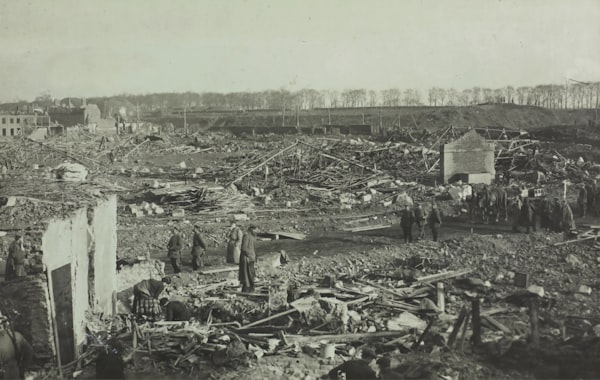
When the uprising finally collapsed on October 2, 1944, approximately 16,000 Home Army fighters and up to 200,000 civilians were dead. Hitler ordered that Warsaw be razed to the ground. German demolition squads systematically destroyed what the fighting had left standing, block by block, building by building. By the time the Soviets finally crossed the Vistula in January 1945, eighty-five percent of Warsaw had been reduced to rubble. The city that the Home Army had fought to liberate was gone.
The Danish Rescue: A Nation Says No
Denmark's experience under German occupation was unique. The country had surrendered almost immediately in April 1940, and the Germans, regarding the Danes as a fellow "Nordic" people, allowed the Danish government to remain in place and Danish institutions to function with relative autonomy. Danish Jews — approximately 7,800 people — were left largely unmolested for the first three years of occupation. Then, in September 1943, the arrangement collapsed. The Danish government resigned rather than comply with German demands, and the word leaked out: the Gestapo was planning to round up Denmark's Jews on the night of October 1.
What happened next was one of the most extraordinary episodes of the entire war. Within days, an improvised rescue operation involving thousands of ordinary Danes — fishermen, doctors, teachers, taxi drivers, students, police officers — smuggled nearly the entire Jewish population of Denmark across the narrow strait of the Øresund to neutral Sweden. Jews were hidden in churches, hospitals, private homes, and even the trunk of an ambulance driven by a teenager. Fishermen loaded their boats with human cargo and made the dangerous crossing at night, risking mines, German patrol boats, and the cold autumn sea. In the space of roughly three weeks, approximately 7,200 of Denmark's 7,800 Jews were transported to safety. Fewer than 500 were captured by the Germans.
The Danish rescue defies easy explanation. Other occupied countries with longer traditions of antisemitism had far worse records. What made Denmark different? Historians point to several factors: the small size of the Jewish community and its deep integration into Danish society; the warning that came in time, leaked by a German diplomat named Georg Ferdinand Duckwitz who could not stomach the planned deportation; the proximity of neutral Sweden; and a Danish national culture that simply did not accept the premise that some citizens were less Danish than others. Whatever the explanation, the result was singular. An entire nation, faced with the machinery of genocide, collectively refused to cooperate.
The White Rose: Courage in the Heart of the Reich
Not all resistance took place in occupied countries. In Munich, in the very heart of the Third Reich, a small group of university students dared to challenge the Nazi regime with the most dangerous weapon of all: the truth. The White Rose — die Weiße Rose — was founded by Hans Scholl and his sister Sophie, along with their friends Christoph Probst, Alexander Schmorell, Willi Graf, and their philosophy professor Kurt Huber. Between June 1942 and February 1943, they wrote, printed, and distributed six leaflets calling on the German people to resist the Nazi regime.
The leaflets were extraordinary documents — literate, passionate, and unflinching. They named the regime's crimes explicitly. "Since the conquest of Poland, 300,000 Jews have been murdered in the most bestial manner," the second leaflet declared, at a time when most Germans claimed ignorance of the Holocaust. The leaflets quoted Aristotle, Goethe, and Schiller. They appealed to Germany's intellectual and moral traditions. They called the war criminal and unwinnable. And they urged passive resistance — sabotage of the arms industry, refusal to donate to Nazi organizations, and the spread of the leaflets themselves.
Hans and Sophie Scholl were arrested on February 18, 1943, after a university janitor saw Sophie throwing leaflets from a balcony into an atrium at the University of Munich. They were interrogated by the Gestapo, tried before the notorious People's Court judge Roland Freisler, and found guilty of treason. They were executed by guillotine on February 22 — four days after their arrest. Sophie was twenty-one years old. Hans was twenty-four. Christoph Probst, also tried that day, was twenty-three and the father of three small children. In the months that followed, the remaining members of the White Rose were arrested and executed as well.
"Somebody, after all, had to make a start. What we wrote and said is also believed by many others. They just don't dare express themselves as we did."
— Sophie Scholl, on the day of her execution
The White Rose accomplished nothing in military terms. The leaflets did not slow the German war machine by a single hour. But their moral significance was immense. They proved that conscience survived even in the heart of a totalitarian state, that not every German had been silenced or seduced by Nazi ideology. After the war, copies of the sixth leaflet — smuggled out of Germany and reprinted by the Allies — were dropped by the millions over German cities. The words of a handful of students in Munich became one of the most powerful documents of moral resistance in the twentieth century.
Partisan Warfare: Yugoslavia and the Soviet Union
While resistance in Western Europe was largely clandestine — intelligence gathering, sabotage, escape networks — in Eastern Europe and the Balkans, it took the form of full-scale guerrilla warfare. Nowhere was this more dramatic than in Yugoslavia, where Josip Broz Tito built the Partisans into the largest and most effective guerrilla army in occupied Europe.
Tito's Partisans were remarkable in almost every respect. They began in 1941 as a small band of communist fighters and grew into an army of 800,000 by 1945. They fought not only the German and Italian occupiers but also the Chetniks, a rival Serbian nationalist resistance movement, and the Croatian fascist Ustaše regime. The Partisans operated in the rugged mountains of Bosnia, Montenegro, and Serbia, fighting a war of relentless movement — attacking, withdrawing, regrouping, and attacking again. The Germans launched seven major offensives against them between 1941 and 1944, each time failing to deliver a decisive blow. Tito himself was nearly killed or captured on multiple occasions, once escaping a German airborne assault on his headquarters in the Bosnian town of Drvar by climbing out of a cave on a rope.
Behind the Eastern Front, Soviet partisans waged a parallel war of extraordinary scale and brutality. Operating in the vast forests and marshes of Belorussia, Ukraine, and western Russia, an estimated 280,000 to over a million partisans disrupted German supply lines, destroyed railway bridges, ambushed convoys, and made the German rear area a zone of constant danger. The "Rail War" of 1943 alone saw partisans destroy over 200,000 sections of railway track, severely disrupting German logistics during the critical Battle of Kursk. German reprisals were savage — entire villages were burned and their populations massacred in retaliation for partisan attacks — but the violence only drove more people into the forests to join the fighters.
Women in the Resistance
The Resistance could not have functioned without women, yet their contributions have been systematically underrecognized by history. Women served as couriers, carrying messages and weapons past German checkpoints in shopping bags and baby carriages. They ran safe houses. They operated clandestine radios. They forged documents. They nursed wounded fighters. And many of them fought with weapons in their hands, killing and dying alongside men.
Nancy Wake, an Australian-born journalist living in France, became one of the Gestapo's most wanted people — they called her "the White Mouse" for her ability to evade capture. She helped run an escape network from Marseille before fleeing to Britain, training with the SOE, and parachuting back into France in 1944 to command a force of 7,000 Maquis fighters in the Auvergne. She led attacks on German installations, personally killed a sentry with her bare hands during one mission, and cycled 500 kilometers through German checkpoints to replace a destroyed radio transmitter. After the war, she was one of the most decorated women of the conflict.
Virginia Hall, an American from Baltimore, walked with a prosthetic leg she called "Cuthbert" — she had lost her left foot in a hunting accident before the war. This disability would have barred her from most intelligence services, but the SOE saw her determination and sent her into France as one of their first agents in 1941. Operating under cover as a journalist, she organized resistance networks across central France, arranged arms drops, helped escaped prisoners of war, and ran her circuits with such skill that the Gestapo identified her as "the most dangerous of all Allied spies." She escaped over the Pyrenees on foot — on her prosthetic leg, through snow — when the Germans occupied Vichy France. She later returned to France with the American OSS, disguised as an elderly peasant woman, and continued her work until liberation.
Violette Szabo, a young Anglo-French widow whose husband had been killed fighting with the Free French at El Alamein, volunteered for the SOE at the age of twenty-two. On her second mission into France, she was captured after a firefight with a German patrol during which she provided covering fire so her companions could escape. She was interrogated, tortured, and sent to Ravensbrück concentration camp, where she was executed by firing squad in early 1945. She was twenty-three years old. She was posthumously awarded the George Cross — Britain's highest civilian honor for bravery.
Andrée de Jongh, a young Belgian woman barely five feet tall and twenty-four years old, created the Comète escape line — a network that smuggled more than 800 Allied airmen from Belgium, through France, over the Pyrenees, and into Spain. She personally guided many of them across the mountains, making the dangerous crossing thirty-two times. Captured in 1943, she survived imprisonment in Ravensbrück and Mauthausen concentration camps and lived to the age of ninety.
"I hate wars and violence, but if they come, I don't see why we women should just wave our men a proud goodbye and then knit them balaclavas."
— Nancy Wake
The Cost: Betrayal, Torture, and the Price of Courage
The Resistance was not romantic. It was terrifying, lonely, and often fatal. Every person who joined a clandestine network understood that capture meant interrogation, and interrogation meant torture. The Gestapo and its collaborators — the French Milice, the Dutch security police, the various fascist militias across Europe — were expert at extracting information. Waterboarding, electric shocks, beatings, the crushing of fingers, the tearing out of fingernails — these were standard procedures. Many agents carried cyanide capsules for the moment when resistance to interrogation became impossible, choosing death over the risk of betraying their comrades.
Betrayal was the constant fear. Networks were infiltrated by double agents. Neighbors informed on neighbors for money, for safety, or out of genuine ideological conviction. In the Netherlands, a catastrophic infiltration known as the Englandspiel — the "England Game" — allowed the Germans to capture SOE radio operators and use their sets to lure more agents and supply drops into German hands. Over the course of nearly two years, fourteen agents were parachuted directly into German custody. Most were sent to Mauthausen concentration camp and executed. The SOE in London, despite increasingly urgent signals that something was wrong, continued to send men to their deaths.
The reprisals were savage. When Reinhard Heydrich, the architect of the Holocaust and the German governor of occupied Czechoslovakia, was assassinated by Czech agents in Prague in May 1942, the German response was the annihilation of the village of Lidice. Every man in the village was shot. The women were sent to Ravensbrück. The children were dispersed — some sent to be "Germanized" in German families, others to extermination camps. The village itself was razed, plowed under, and erased from the map. In France, the massacre at Oradour-sur-Glane in June 1944 saw an SS division murder 642 men, women, and children — including 247 women and children locked in the church and burned alive — in retaliation for Resistance activity in the region.
These atrocities were designed to terrorize occupied populations into submission, to make the cost of resistance so appalling that no one would dare. And for many people, they succeeded. The majority of citizens in every occupied country kept their heads down, followed the rules, and tried to survive. This was not cowardice — it was the rational calculus of people with families to protect and no guarantee that resistance would accomplish anything beyond getting them killed. The moral landscape of occupation was not a simple division between heroes and collaborators. Most people lived in the vast gray space between, making compromises they were not proud of, doing what they could within the limits of what they could endure.
But in every country, in every city and village, there were those who stepped out of the gray and into the light — or, more precisely, into the shadows. They chose danger over safety, conscience over comfort, the chance to resist over the certainty of survival. Many of them died. Many are forgotten. Their names do not appear in history books; their graves, if they have graves at all, bear no special distinction. They were farmers and students and housewives and professors and fishermen and nurses, and they chose to fight.
The legacy of the Resistance is not measured in military victories, though its contributions to the Allied war effort were significant. It is measured in something harder to quantify but no less real: the demonstration that tyranny, no matter how total, never fully extinguishes the human capacity for defiance. That in the darkest hour, ordinary people are capable of extraordinary courage. That the choice to resist — even when resistance seems hopeless, even when the cost is everything — is never meaningless.
Somewhere in the French countryside, there is a cellar beneath a barn where an American airman once hid for eleven days. The farmer who sheltered him is long dead. The airman, if he survived the war, went home to a country that never knew his rescuer's name. But the choice Jean-Pierre Moreau made in the rain that night — to open his door, to say yes, to risk everything for a stranger — endures. It endures because it was not unique. It was one of a million acts of quiet courage that, taken together, form one of the most extraordinary chapters of the Second World War. The Resistance did not win the war. But it proved that even in the deepest darkness, the human spirit refuses to be extinguished.