Dawn had not yet broken over the English Channel when the first wave of landing craft began their approach. It was June 6, 1944 — a date that would become synonymous with courage, sacrifice, and the beginning of the end for Nazi Germany's grip on Western Europe. The soldiers crouched in their boats, many of them barely out of their teens, listening to the drone of engines and the distant thunder of naval bombardment. What awaited them on the beaches of Normandy would test the limits of human endurance.
Operation Overlord, as it was officially known, was the culmination of years of planning, deception, and logistical brilliance on a scale the world had never seen. Supreme Allied Commander General Dwight D. Eisenhower had agonized over the decision, watching weather reports with the intensity of a man who understood that the fate of millions rested on whether the clouds would break. On the evening of June 5th, he made the call. The invasion was on.
Quick Facts
The Five Beaches
The invasion targeted five beaches along a 50-mile stretch of the Normandy coastline, each assigned a code name that would echo through history: Utah, Omaha, Gold, Juno, and Sword. American forces were responsible for Utah and Omaha, while British and Canadian troops would assault Gold, Juno, and Sword.
At Utah Beach, the landing went more smoothly than anyone dared hope. A strong current had pushed the landing craft nearly two kilometers south of the intended target, but this turned out to be a stroke of luck — the defenses there were lighter. Brigadier General Theodore Roosevelt Jr., the eldest son of the former president and the oldest man in the invasion at 56, calmly assessed the situation and made the now-famous decision: "We'll start the war from right here."
"You are about to embark upon the Great Crusade, toward which we have striven these many months. The eyes of the world are upon you."
— General Dwight D. Eisenhower, Order of the Day, June 6, 1944
The Horror of Omaha
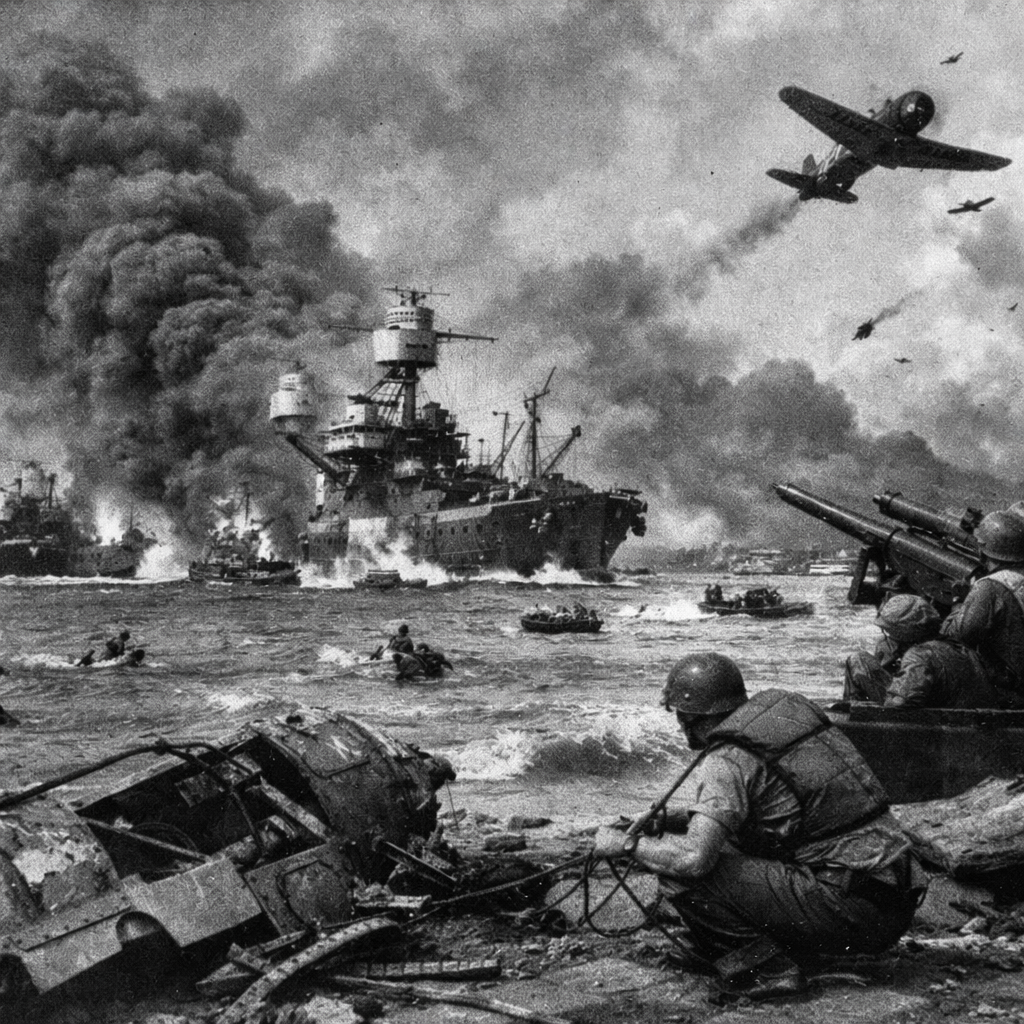
Omaha Beach was a different story entirely. The cliffs above the beach gave German defenders a commanding view of the landing zone, and the initial bombardment had failed to neutralize their positions. As the ramps dropped on the landing craft, soldiers were met with a wall of machine gun fire. Many never made it off the boats. Those who did found themselves pinned down on a narrow strip of sand, with the tide rising and enemy fire coming from every direction.
For the first few hours, the situation at Omaha was so desperate that General Omar Bradley seriously considered abandoning the beach entirely. It was only through the extraordinary courage of small groups of soldiers — Rangers scaling the cliffs at Pointe du Hoc, engineers blowing gaps in the obstacles under fire, infantry finding seams in the defenses — that the beach was eventually secured. The cost was staggering: nearly 2,000 American casualties at Omaha alone.
The Airborne Assault
Before the first landing craft hit the beaches, thousands of paratroopers had already dropped behind enemy lines under the cover of darkness. The American 82nd and 101st Airborne Divisions jumped into the hedgerow country behind Utah Beach, while British 6th Airborne Division seized key bridges on the eastern flank. Many paratroopers were scattered across the countryside, far from their intended drop zones, but they adapted and improvised, creating confusion and disruption that prevented the Germans from mounting a coordinated counterattack.
The Turning of the Tide
By the end of June 6th, the Allies had established a fragile but undeniable foothold on the continent of Europe. Over 156,000 troops had crossed the Channel. The cost had been enormous — roughly 10,000 Allied casualties, with more than 4,000 confirmed dead — but the beaches were secured. In the days and weeks that followed, the beachhead expanded, and the liberation of France began in earnest.
D-Day did not end the war. That would take another eleven months of brutal fighting across France, Belgium, and into Germany itself. But it was the moment when the outcome became inevitable. The fortress that Hitler had built around his empire had been breached, and there was no closing the gap.
Today, the beaches of Normandy stand as a monument to what was achieved that day. The rows of white crosses at the American cemetery overlooking Omaha Beach, the preserved bunkers and craters, the museums and memorials — all exist to ensure that the sacrifice of those young men is never forgotten. They crossed an ocean, stormed a beach, and changed the world.